Tuesday, May 27, 2014

During the spring semester, the University of Texas Marine Science Institute (UTMSI) was host to the undergraduate program “Semester by the Sea”. This program allows undergraduates from the University of Texas at Austin (UT) to come down to Port Aransas for a semester to take marine science courses and perform independent research in a faculty member’s lab. As a Gulf of Mexico Research Initiative (GoMRI) funded consortium, DROPPS is always looking for ways to incorporate GoMRI legacy goals. One of these goals is to inform and train future scientists and engineers. DROPPS participation in Semester by the Sea does just that. Students are placed into specific labs based on their research interests. As a result of this selection process, DROPPS had three students participate in the program: Sara Garcia, Andrew Kang, and Donald Flynn.
DROPPS Semester by the Sea students (L to R): Andrew Kang, Sara Garcia, and Donald Flynn
Sara is currently a junior at UT, majoring in marine science and business foundations. She was selected to work in DROPPS consortium director Dr. Ed Buskey’s lab and was mentored by DROPPS Research Associate Dr. Brad Gemmell. Sara was initially interested in joining an oil spill science lab because her family works in the oil and gas industry. She has a strong interest in how human-caused impacts, such as oil spills, affect the environment. Her independent research project looked at the impact that oil, dispersant, and oil+dispersant had on the swimming behavior of barnacle nauplii. Sara found that crude oil and oil+dispersant had a negative impact on the swimming velocity of the nauplii, but she did not find this same effect using dispersant alone. In addition to performing research in the lab, Sara was able to assist with numerous DROPPS outreach activities including school visits and science nights.          
Sara Garcia participates in a DROPPS outreach event. 
When speaking about her experience with DROPPS, Sara had the following to say: 
“Working in the lab this semester was both exciting and rewarding. I really enjoyed learning different lab techniques, software, and how to formulate and analyze data. It was a great opportunity to be able to learn from and be supported by a knowledgeable community. Also, being able to do outreach opportunities locally has been a fun and an interactive opportunity to share what I'm learning.”
Andrew Kang presents his research during the Semester by the Sea Research Symposium.
Andrew is a senior at UT. He worked in the lab of Dr. Zhanfei Liu, a DROPPS Co-PI, and was co-mentored by DROPPS Post-doctoral Fellow Dr. Hernando Bacosa and Research Scientist Jiqing Liu. Andrew wanted to perform research in an oil spill lab because he thought it would be important to contribute to a collective effort on understanding the effects of oil spills. Andrew studied the bacterial breakdown of n-alkanes compounds in crude oil. Andrew looked at the degradation rate in three different concentrations of oil.  The most interesting thing he found was that the bacteria were still very effective in degrading the oil even though the oil was present at high concentrations. Like Sara, Andrew enjoyed his lab experience immensely and had the following to say:
“I worked with a number of knowledgeable, amiable, and helpful scientists in the lab. These people helped and guided me along the way so that I can understand and know what I was doing. My mentor, Dr. Zhanfei Liu, provided me with a mindset to approach my research so that I could enjoy and be confident in what I was doing.”
Donald Flynn gives his presentation during the Semester by the Sea Research Symposium.
Donald is currently a junior at UT. He worked in DROPPS Co-PI Dr. Deana Erdner’s lab and was also mentored Dr. Hernando Bacosa. While not initially interested in working in an oil spill lab, by the end of the semester he was glad he did. Donald is originally from New Orleans, LA, so researching the impacts that the Deepwater Horizon spill had on the environment hit close to home. Donald investigated the effects of two toxic hydrocarbons on the phytoplankton species Alexandrium tamarense.  He found that the phytoplankton was more resilient to toxins when associated with natural bacteria assemblages.  Donald also had great things to say about his experience:
I got to work with very talented post docs and professors that helped me learn a wide variety of skills in the laboratory. I got to work with various chemicals and appliances, and develop my abilities as a researcher far more than I expected to in just one semester. Most of all I got the thrill of seeing my hard work in the laboratory lead to some very interesting and meaningful results."
DROPPS participation in Semester by the Sea was a huge success. The students found interesting results and gained hands-on experiences in the scientific method. Additionally, all three students said that as result of their experience, they are now interested in going to graduate school and pursuing scientific research as a career. Sara and Andrew will be continuing their projects this summer when they come back to Port Aransas to take summer courses. The Semester by the Sea program gave out a national travel meeting award and a regional travel meeting award to the students who excelled in their research and presentations. Sara was awarded the national travel meeting award and Andrew was awarded the regional travel meeting award. The consortium is proud of these three DROPPSters and we look forward to seeing where their scientific futures will take them. 

Monday, March 17, 2014


Hello! My name is Lambert Aryee. I am a high school senior at Baltimore Polytechnic Institute (Poly). I am involved in the Research Practicum curriculum offered at Poly. The Research Practicum course allows students like me an opportunity to experience the life of research in a real institutional facility, such as the one here at Johns Hopkins. Currently, I am researching in the Oil Spill lab under the supervision of David Murphy, a postdoctoral fellow here at the Homewood Campus. I am a rookie to the DROPPster world. I am a full-time student at Poly and a visiting undergraduate student here at Hopkins. I started my research journey in September and will conclude in May.


Lambert Aryee, Class of 2014

On a daily basis, I arrive at Hopkins around 1:00 pm and meet David to discuss the objective of that particular day. I have performed most aspects of conducting a successful research experiment. I have read journal articles and written summaries about them. I have also started working on my mini-project for the year. My project involves using the simple piezoelectric droplet generator (Yang et al 1997) to visualize the impact dispersant droplets have on an oil slick. With this information, I will be able to understand the physics of the process so we can know the ideal droplet size relative to oil slick properties.

Re-design of Simple Piezoelectric Droplet Generator (Yang et al 1997)


My experiment involves the use of seawater, which we will mix in the lab, and dispersants which are liquid blends of surfactants and solvents designed to speed breakup of oil slicks into fine droplets that disperse naturally in the sea. 


Special salt used to create seawater for experiments.

Having the opportunity to conduct research in an environment like the one provided to me here at the Johns Hopkins Homewood Campus is a dream come true. I look forward to coming to the lab every day. Soon, I will be attending college, and the experience I have encountered here will transfer into shaping my future as I pursue the field of mechanical engineering. I love the opportunity I have here at Hopkins, and would not exchange it for another!


Wednesday, February 19, 2014

Greetings from Ed Buskey, the PI for the DROPPS consortium.  Recently, I had the opportunity to attend an International Symposium on Deep Sea Oil Spills in Qingdao, China. I was invited by Piers Chapman, the PI and director of the GISR Consortium at Texas A&M University (TAMU), College Station. Even though I already had travel plans for the weeks before and after this meeting, I decided I could not pass up this opportunity.


Traveling to Qingdao was quite the experience. I left at 7 AM on a Saturday morning and first flew from Corpus Christi to Houston, where I met up with my colleagues from TAMU. We then flew to Chicago where we caught a non-stop, 13 hour flight to Beijing, China, which took us over the North Pole. Our last flight was a short one to Qingdao on the coast of China, followed by a long drive to our hotel. With the 11 hour time difference it was about 9 pm on Sunday night when I finally got to sleep in my hotel bed.


Qingdao waterfront


The meeting started the next morning at 9 am. We had 12 speakers the first day and 6 speakers on the second day, with a mix of Chinese scientists and guest speakers from the US and Australia, each with 30 minutes to present.  There was a lot of interest and discussion of subsurface application of dispersants at the wellhead, pointing out the advantages of this approach including the longer time it takes for droplets to reach the surface (days to weeks versus hours), the larger surface area for dissolution of soluble compounds and colonization by hydrocarbon degrading bacteria, and the more rapid dilution of toxic compounds. Oil that reaches the surface may be skimmed under ideal conditions, but if it reaches sensitive coastal habitats attempts to remove the oil may cause more damage than the oil itself. Oil that reaches vegetated shorelines will often kill the vegetation and increase erosion. Anaerobic sediments in many coastal habitats are not effective in breaking down petroleum hydrocarbons. Piers Chapman gave an overview of the research from the GOMRI GISR consortium, and I presented on the DROPPS consortium results.

We had a short opportunity to be tourists in Qingdao on Wednesday and Thursday before returning to the US. On Wednesday morning we visited Laoshan, a very tall mountain next to the sea that is home to a Taoist temple. In the afternoon we visited the Tsingtao Brewery, the second largest in China, which was started during the German occupation of this region of China early in the 20th Century. Of course our visit included some beer sampling.
Laoshan mountain and temple entrance

On Thursday we were given the opportunity to do some shopping. We visited an open market with lots of vendors where you have to haggle over the price. We also visited a green tea wholesale shop and a large department store.

Our Chinese hosts treated us exceptionally well, and we had the chance to share meals of seafood delicacies that included sea cucumber and other fish and shellfish that I was not always able to identify. Evening meals were always served on a circular table with a large glass “lazy susan” to allow easy sharing of food and beverages. Our Chinese hosts were very fond of making repeated toasts toasts with beer, wine or mao-tai, a very strong beverage that is over 50% alcohol! This definitely made it easier to eat some of the difficult to identify sea creatures our gracious hosts ordered for us.

Unidentified seafood at dumpling restaurant


Dinner on “beer street” with a traditional round table with lazy susan


Tuesday, December 17, 2013


Hi! I'm CJ Beegle-Krause, a researcher at SINTEF, in Trondheim, Norway. I work with a large group of people working to better understand oil spills. Some people work on the chemistry and toxicity of oil, while my team works on computer modeling of the oil in order to answer many questions such as "Where does the oil go?", "How does the oil change in the environment?", and "What are the potential environmental impacts of the oil?" Additionally, we have some people working on how to clean up spilled oil. We  perform laboratory and open ocean field work with oil as well as develop computer models.

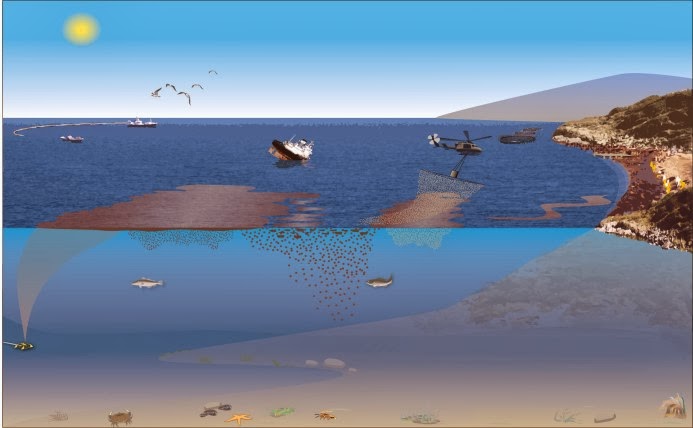
The picture above shows two types of spills: a leaking ship and a subsurface well. The oil will be located on the water surface and in the water column. Collecting oil with a towed boom and application of chemical dispersants from a helicopter are two response options shown in the picture, though there are more options such as in situ burning. Models can help responders evaluate different response measures as they formulate their plans. Winds and waves can disperse oil into the water column as droplets, and chemical dispersants also change the surface oil into smaller droplets in the water column.  In the DROPPS project we are working to improve modeling of the droplet related processes, particularly related to potentially applying chemical dispersants. A great deal of research goes into making a computer model appropriate for making decisions in real life situations.

For oil droplets, how small is small? Let's talk in terms of a human hair, which ranges in diameter from 17µm (pale blonde) to 181µm (black) (Thanks Wikipedia![1]). The lower end of this range is at the limit of what the human eye can perceive.

Oil droplets are small, but they are big news in understanding the movement and potential impacts of oil spills. The rise speed of an oil droplet is proportional to the droplet's diameter. Droplets that you can barely see will rise very slowly. Larger droplets, say millimeters in diameter, will rise more quickly, and can reach the ocean surface in a matter of hours from deep in the ocean. Smaller droplets take longer to rise, and very small droplets at ~10 µm in diameter are too small to rise, as they are trapped by friction with the water.
The mini Tower Basin
 

Why is something so small so important? The droplet size distribution determines how much of the oil will remain within the ocean, and how much will rise at the surface. During an oil spill, responders may have the option to add chemical dispersants to the spill, either from the surface or subsurface, to alter the droplet. Chemical dispersants break up oil into smaller droplets, so more of the oil stays within the water column. If a spill is in an area with many water birds, keeping as much oil as possible in the water column may be better, so chemical dispersants might be used immediately. On the other hand, if the spill is in a sensitive coral reef area, leaving the oil at the surface may be better, with cleanup using booms and skimmers to remove surface oil. In the US, response decisions are made jointly within the Unified Command, whose members include the U.S. Coast Guard, Trustee Federal and State Agencies, and the responsible party. They use output from computer models to evaluate the oil spill’s predicted path and any changes in the oil location from the potential use of chemical dispersants.

The Tower Basin


SINTEF has a new Tower Basin, which is 6 m high and 2 m wide: a big tank for making small droplets. We use it to simulate deepwater well blowouts. We do experiments to release different oil types under pressure through a small nozzle, and use different chemical dispersant ratios injected into the rising plume of oil droplets to change the droplet size distribution.

The modeling group works to put together the laboratory and field work with mathematical models in order to make predictions about where the oil will go in an oil spill, and how one might clean that oil up. We work on software called OSCAR (Oil Spill Contingency And Response) and DREAM (Does-related Risk and Effect Assessment Model). These models help people plan for and respond to oil spills.

Members of the Sintef modeling group


Tuesday, November 26, 2013


Hey everyone! My name is Liana Vaccari and I’m a PhD student in Chemical Engineering at the University of Pennsylvania. The research group I’m a part of has spent a lot of time understanding how things change at fluid interfaces, especially with microscopic particles. I took that know-how to look at the behavior of the oil-seawater interface when it is covered with a natural microparticle: bacteria. In the ocean, there are some bacteria that know when even small amounts of oil are present and they can feed on it. Encouraging them to eat the oil is a great way to get rid of this pollutant, but it’s definitely not that simple. Some bacteria species also form strong biofilms on various surfaces, and I’m studying the evolution of a biofilm that the bacteria, Pseudomonas sp., make between the oil and seawater. This could affect the way drops get broken up in the water column (something David talked about in his post in October) if the biofilms surround it.

David talked about using the crude oil from the Gulf of Mexico. The reason it’s so nasty is that there are all sorts of molecules that change the properties of interfaces, etc. Therefore, I’ve been using a very simple oil to get a good starting point in understanding what happens just with bacteria present. My experiments are also on a much smaller scale than David’s. The needle in the image below is only 1 millimeter across. For perspective, a millimeter is approximately the thickness of a credit card.

This picture is of an oil drop and an oil layer that I aged in the bacteria suspension for a day. Afterwards, I pressed the drop against the layer above and deformed it significantly, but it didn’t pop! I was surprised at how strong it was,
and decided to learn more about the formation of the film.
 
Basically, I have been tracking how things (bacteria and very tiny beads) behave at the oil-water interface when I let it sit for a couple of days. My main tool for these experiments is a microscope, where I record a huge amount of data.


Soon, I’ll be integrating my work with some of the larger scale projects. This will give us a more realistic view of what is happening in the ocean when these oil spills happen.

Wednesday, October 16, 2013


Howdy! My name is David Murphy, and I’m a postdoctoral fellow in Mechanical Engineering at Johns Hopkins University. I’m working with the other DROPPsters here at Hopkins (and across the world!) to study how oil spreads out in the ocean once it is spilled. It is important to understand how the oil breaks up into smaller and smaller blobs so that we can understand where it will eventually end up. Oil in the ocean can be dispersed due to many different environmental forces, such as currents, turbulence in the ocean, waves on the surface, and mixing created by swimming animals. Here at Hopkins we do experiments to simulate these mixing events in the laboratory so that we can better predict where the oil will go.
In this picture, you can see several of the tanks where we do experiments. The large tank on the right contains an oil/water mixture from one of my experiments.
In order to make our experiments as realistic as possible we are using real crude oil from the Gulf of Mexico. Crude oil is NASTY stuff! It is dangerous since it is flammable; it is also volatile, which means it gives off hazardous fumes. In order to keep us safe, we have a high-powered ventilation system to remove the fumes and fireproof cabinets where we store the oil. We also wear gloves to protect our skin.
The fireproof cabinet where we store the crude oil
Of course, once we have completed an experiment, we have to clean up. One of the things I’ve learned as a DROPPster is that oil is hard to clean up! It takes a lot of work to clean out our tanks after doing an experiment, and this makes me sympathize with the folks cleaning up oil on the beaches and in the marshes after a real oil spill. As we clean up in the lab, we can’t drain the oily water into the sewer, so we have a skimmer that separates the oil from the water. We can then collect the oil and dispose of it properly.

The skimmer and oil barrel where we collect oil after an experiment

Cleaning up after an experiment in our sink that drains to the skimmer
Finally, I want to give a little taste of what oil looks like when it is mixing with water. In the video below, oil that has been mixed with dispersant is leaking out of a nozzle to form a plume. This simulates oil rising from an oil well blowout on the bottom of the ocean. Like dish soap, dispersant reduces the interfacial tension between the water and the oil and allows the oil to break up into tiny droplets that will disperse in the ocean more easily. We’re studying how dispersant interacts with environmental flows to promote oil dispersal.


Monday, September 30, 2013


Hi! My name is Tracy Harvey and I am a master’s student at the University of Texas at Austin Marine Science Institute (UTMSI). Here at UTMSI, we are investigating the biological impacts of oil spills as part of the DROPPS (Dispersion Research on Oil: Physics and Plankton Studies) Consortium. I have been doing short-term incubation experiments exposing different species of protozoa, a group of unicellular organisms found in the ocean, to crude oil. Understanding protozoa responses to dispersed oil is important because they are a diverse group at or near the base of marine food webs.

One of the coolest species I have worked with is Noctiluca Scintillans (commonly known as 'sea sparkle'). N. Scintillans is a planktonic organism that gets its food by consuming other organisms. It is native to the Gulf of Mexico and is known for its bioluminescence along the coast during winter months, as seen in the picture below. Bioluminescence is the production and emission of light by a living organism and is often used as a defense against predators.

http://www.flickr.com/photos/mutolisp/8728146283/
In order to culture these guys we have to take plankton tows off the UTMSI research pier on incoming tides.


 As you can see, we end up catching a lot more than just N. Scintillans!


Because of N. Scintillans’ transparent balloon-shaped body it is easy to see what is going on internally. Compared to other protozoa cells, these cells are quite large. We are currently in the process of looking at N. Scintillans under the microscope to see if oil exposure changes its behavior. 

My next step is to look at the swimming behavior of other protozoa exposed to crude oil. Be sure to stay tuned to the DROPPS blog for more information on our research!